PT100, 2-3-4Wire Connection and PT1000
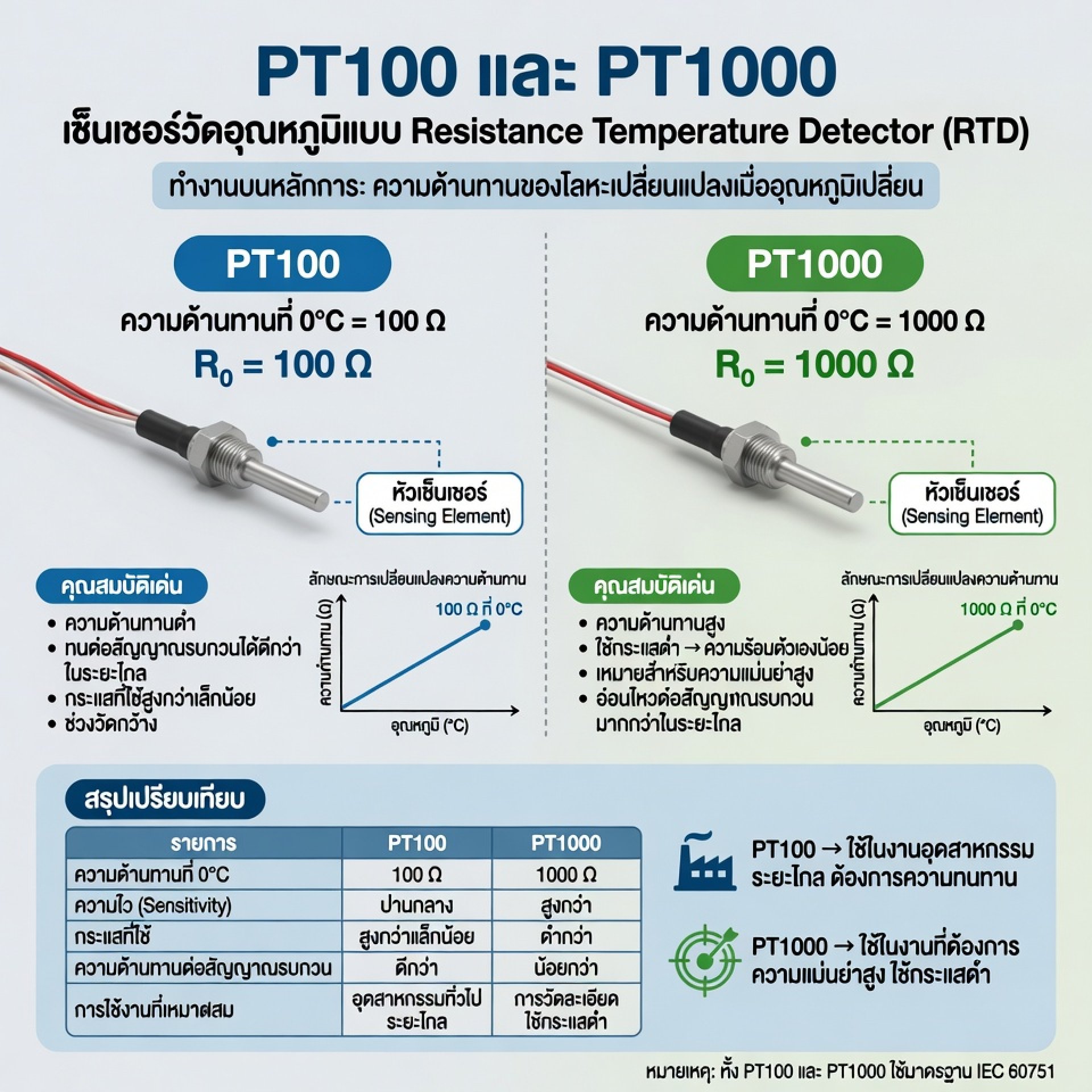
Precise temperature monitoring plays a vital role in industrial environments, particularly when it comes to controlling motor temperatures. PT100 and PT1000 sensors, both platinum resistance temperature detectors (RTDs), have earned a reputation for delivering dependable and accurate temperature readings. Yet, the accuracy you get from these sensors hinges heavily on how they’re wired. Choosing between 2-wire, 3-wire, or 4-wire configurations can greatly affect performance, installation complexity, and overall cost. This article dives into the technical details of PT100 and PT1000 sensors, breaks down their wiring methods, and offers practical advice on selecting the right setup for motor temperature monitoring.
Understanding PT100 and PT1000 Temperature Sensors
PT100 and PT1000 sensors are both platinum-based RTDs, but they differ mainly in their nominal resistance at 0°C: PT100 sensors have 100 ohms, while PT1000 sensors have 1000 ohms. Their principle of operation is straightforward—platinum’s electrical resistance increases predictably as temperature rises, allowing for precise temperature measurement. Because PT1000 sensors have a higher nominal resistance, they’re naturally less affected by the resistance of the lead wires, which is an important factor when deciding on wiring methods.
When it comes to motor temperature control or other temperature monitoring tasks, the choice between PT100 and PT1000 often depends on cable length, the level of accuracy needed, and environmental conditions. PT100 sensors are widely used thanks to their compatibility with many controllers, while PT1000 sensors shine in applications where minimizing lead resistance errors is crucial, especially over longer cable runs or when simpler wiring is preferred.
Wiring Methods for PT100 and PT1000 Sensors
The way you wire these sensors has a direct impact on how accurate your temperature readings will be. This is because lead wire resistance can introduce errors, particularly in industrial settings where cables can be quite long.
2-Wire Connection
The 2-wire setup is the most straightforward and budget-friendly option, involving just two wires connecting the sensor to the controller or measurement device. But this simplicity comes at a cost to accuracy.
How it works: The resistance measured includes both the sensor and the lead wires. So, any resistance in the wiring adds to the sensor’s resistance, skewing the temperature reading.
Advantages:
- Easy to install with minimal wiring effort.
- Cost-effective, making it attractive for projects with tight budgets.
- Works well for short cable lengths where lead resistance is minimal.
Disadvantages:
- No way to compensate for lead wire resistance, which means errors grow as cable length increases.
- Lower accuracy overall, so it’s generally not suitable for precision temperature monitoring or critical motor protection.
Application example: For motor temperature monitoring systems with cable runs under a few meters, a 2-wire PT1000 sensor can deliver acceptable accuracy while keeping installation straightforward and cost low.
3-Wire Connection
The 3-wire configuration is the industry favorite for PT100 sensors, striking a good balance between accuracy, complexity, and cost.
How it works: Three wires of equal length and gauge connect the sensor to the measurement device. This arrangement allows the system to partially compensate for lead wire resistance by measuring the resistance of one lead and subtracting it from the total.
Advantages:
- Effectively reduces errors caused by lead wire resistance, improving measurement accuracy.
- Moderate complexity and cost, making it suitable for a wide range of industrial applications.
- Supported by most temperature controllers and measurement instruments.
Disadvantages:
- Doesn’t completely eliminate lead resistance errors, especially if wire lengths or gauges aren’t perfectly matched.
- Requires careful installation to ensure wire uniformity and maintain accuracy.
Application example: Many motor temperature monitoring setups, including AC motors and Motor ABB systems, rely on 3-wire PT100 sensors to deliver reliable temperature readings without excessive wiring complexity.
4-Wire Connection
The 4-wire method is the gold standard for accuracy, typically reserved for applications where precision is non-negotiable.
How it works: Four wires are used: two supply a constant excitation current to the sensor, while the other two measure the voltage drop across the sensor. This separation means the voltage measurement isn’t affected by the resistance of the lead wires.
Advantages:
- Completely removes the influence of lead wire resistance, offering the highest accuracy.
- Perfect for critical temperature monitoring and calibration tasks.
Disadvantages:
- More complex wiring and higher installation costs.
- Requires measurement instruments capable of handling 4-wire sensing.
Application example: In critical motor temperature protection systems or laboratory calibration environments, 4-wire PT100 sensors provide the most precise and dependable temperature measurements.
PT1000 Sensor Wiring Considerations
Thanks to its higher nominal resistance of 1000 ohms at 0°C, the PT1000 sensor is naturally less affected by lead wire resistance compared to the PT100. This means PT1000 sensors can often maintain decent accuracy even with simpler 2-wire wiring in many real-world situations.
For instance, in motor temperature monitoring where cable lengths are relatively short, using a 2-wire PT1000 sensor can simplify installation without sacrificing too much accuracy. That said, when cable runs get longer or when high precision is essential—like in temperature alarms or protection systems for AC motors—opting for 3-wire or 4-wire wiring is still the safer bet to keep measurement errors in check.
Comparative Analysis of Wiring Methods for PT100 and PT1000 Sensors in Temperature Monitoring and Motor Temperature Control
| Wiring Method | Lead Resistance Compensation | Accuracy | Complexity | Cost | Typical Use Cases |
|---|---|---|---|---|---|
| 2-Wire | None | Low | Simple | Low | Short cables, low accuracy needs, PT1000 sensors |
| 3-Wire | Partial | Moderate | Moderate | Moderate | Industrial temperature monitoring, motor temperature control |
| 4-Wire | Full | High | Complex | High | High precision, calibration, critical motor temperature protection |
Recommendations for Selecting the Appropriate Wiring Method in Temperature Monitoring and Motor Temperature Control
Picking the right wiring method really comes down to your specific needs for temperature monitoring or motor temperature control. Here’s a straightforward guide to help you make that choice:
- 2-Wire Wiring: Ideal for non-critical applications with short cables and when using PT1000 sensors. It’s a budget-friendly, simple solution where small measurement errors won’t cause issues.
- 3-Wire Wiring: The go-to option for general industrial temperature monitoring and motor temperature control with PT100 sensors. It strikes a good balance between accuracy, complexity, and cost.
- 4-Wire Wiring: Best for situations demanding top-tier accuracy, like critical temperature alarms, protection systems, or calibration tasks involving long cables. Although it’s more complex and costly, it delivers the most reliable measurements.
Case Study: Motor Temperature Monitoring in an Industrial Facility
At an industrial plant managing several AC motors, PT100 sensors wired in a 3-wire configuration were chosen to provide dependable motor temperature control. This setup offered accurate temperature readings that were good enough to trigger alarms and protect the motors, all without the added complexity of 4-wire wiring. For one particularly critical motor, the team opted for a 4-wire PT100 sensor setup, which enhanced measurement accuracy and provided an extra layer of protection where it mattered most.
Conclusion
For engineers, technicians, and professionals working with temperature monitoring and motor temperature control, understanding how PT100 and PT1000 sensors are wired is key. While the 2-wire setup is simple and cost-effective, it’s limited by errors from lead resistance. The 3-wire method is the most widely used, offering a solid compromise suitable for most industrial uses, including motor ABB systems. When accuracy is paramount, the 4-wire configuration stands out as the best choice. By carefully matching your wiring method to your application’s demands, you can build temperature monitoring systems that are both reliable and precise, ensuring effective motor temperature management.
For more detailed wiring diagrams, product specs, and sensor options, it’s worth consulting manufacturers specializing in platinum RTD sensors, such as JUMO and other leading suppliers. These resources offer valuable insights for implementing PT100 and PT1000 sensors across various temperature monitoring and motor temperature control scenarios.
